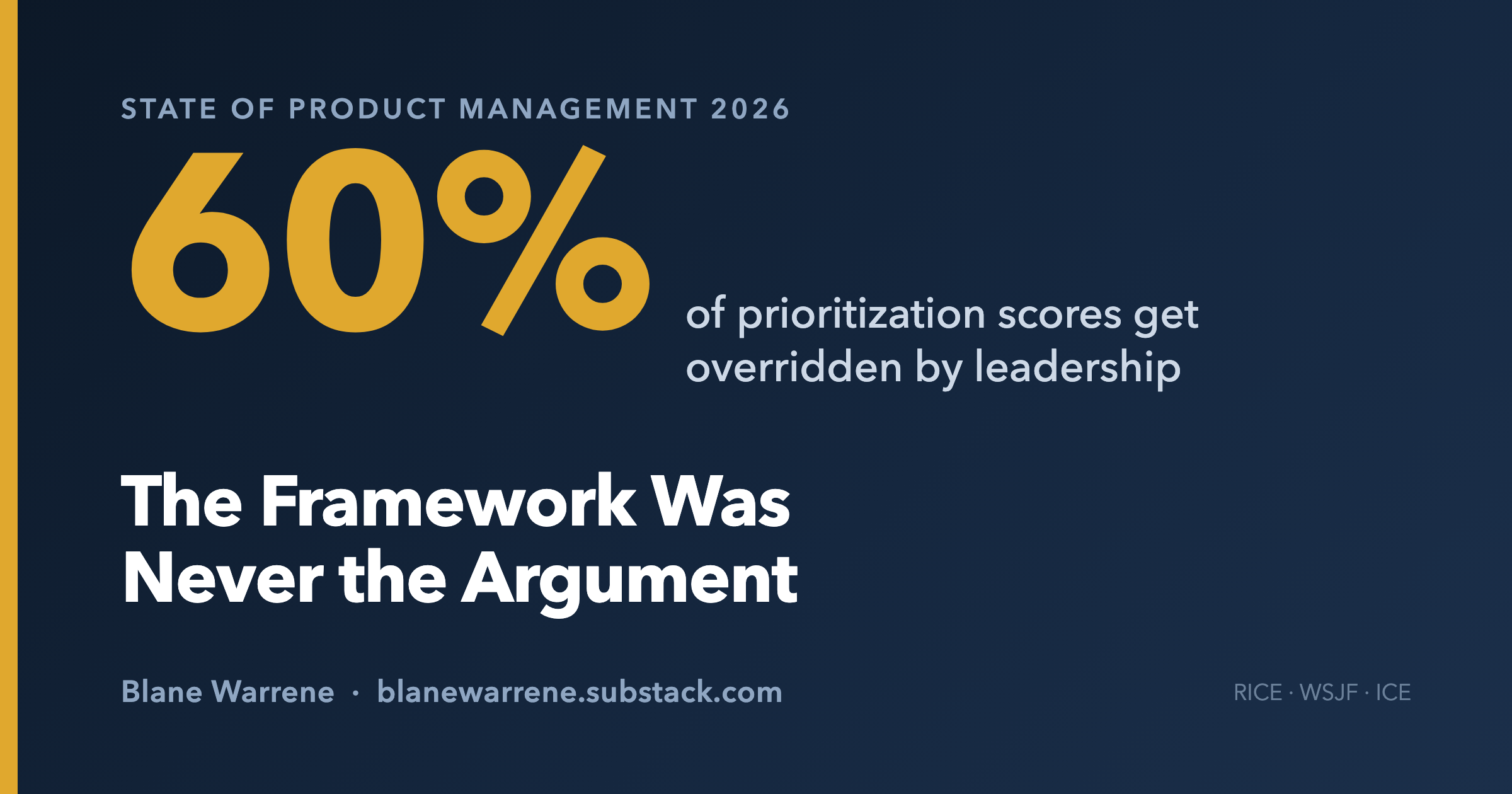
60% of prioritization scores are overruled by leadership. That is not a process failure. It is a signal about where product authority actually lives.
ProductPlan’s State of Product Management 2026 surveyed nearly 250 product professionals in the last quarter of 2025, split fairly evenly between individual contributors and product leaders. One number from that report should stop every head of product mid-scroll: over 60% of prioritization frameworks are routinely overridden by leadership escalation.
RICE, WSJF, ICE. The scoring systems we teach, defend in interviews, and wire into our tools. More often than not, the executive in the room reaches past them and reorders the list anyway.
The instinct is to read that as a discipline problem. Leadership won’t respect the process. The frameworks aren’t being honored. If we could just get executives to trust the math, the product would finally run on rigor rather than politics.
That reading is wrong, and it is about to cost product leaders the next few years if they keep believing it.
The Framework Was Always a Proxy
A prioritization score is not an argument. It is the compressed output of one. RICE takes reach, impact, confidence, and effort, multiplies and divides, and hands you a number. The number feels like authority because it is quantitative and repeatable. But every input was a judgment call someone made, usually under uncertainty, often optimistically, and the framework’s job was only ever to make those judgments legible and comparable.
When an executive overrides a RICE score, they are not rejecting arithmetic. They are rejecting one or more of the judgments underneath it because they hold context that the score never captured. A board commitment. A competitive threat that has not yet surfaced in the data. A strategic bet that pays off in eighteen months and scores terribly on a ninety-day impact estimate.
Sometimes that override is the executive being undisciplined. Often, it is the executive who is right about something the framework had no way to see. The honest product leader has to sit with both possibilities, because the same survey shows the top causes of roadmap misalignment are resource and capacity constraints (49.2%) and shifting priorities tied to short-term commitments (47.5%). Those are not failures of scoring. They are the actual conditions in which the product is practiced.
The framework was never the source of authority. It was a proxy for a conversation, and when the conversation went well, nobody needed to escalate. When the conversation is missing, the score becomes the only thing standing between the product and a reorder, and it loses 60% of the time.
The Risk With AI and Prioritization Scores
Here is where the next two years get interesting, and where I think most of the commentary is about to get it backward.
The clear direction of travel is AI scoring the backlog for us. Auto-estimate effort, infer reach from usage data, and score confidence against historical accuracy. The pitch is seductive: take the human bias out of prioritization and let the model rank the work. Plenty of teams are already moving this way even as, per the same report, more than half of organizations remain cautious about expanding AI adoption at all.
The assumption baked into that pitch is that cheaper, more rigorous scoring will close the override gap. Make the math good enough, and leadership will finally defer to it.
I would not bet on it, and here is the risk I would watch. When prioritization scores were expensive to produce, they carried a kind of earned weight, a quarter’s worth of debate compressed into a ranking. When a model can regenerate the entire scored backlog in seconds, the score may stop feeling like a hard-won position and start feeling like a draft. Easy to produce is easy to dismiss. If that holds, the override does not become rarer as scoring becomes cheaper. It gets more frequent, and more casual, because there is less visible human conviction for an executive to push against.
The mechanism is worth naming even if the magnitude is still unknown. AI does not raise the cost of overriding product. It lowers the cost of generating the thing that gets overridden. The rigor moves to the machine, and the rigor was never the part that won the room.
What Actually Survives Executive Overrides
The product leaders whose priorities survive contact with executive pressure are not the ones with the cleanest RICE spreadsheet. They are the ones who have already had the conversation the score was standing in for. They walk in with the strategic logic, the tradeoff made explicit, and the one sentence that connects this piece of work to the outcome the executive actually cares about. The framework is in their back pocket as supporting evidence, not leading with it as if the number argues for itself.
This is the reframe the 2026 data points to, and the report says it plainly in another finding: senior leadership ownership of product direction rose, and PMs are increasingly executing against mandates tied to financial outcomes rather than setting direction unchallenged. Nearly three-quarters of PMs in the survey expect their roles to span more disciplines. The job is moving from scoring the work to making the case for it, and those are different skills.
Influence and narrative are not soft alternatives to rigor. They are the harder discipline. It is far easier to compute a RICE score than to walk into a room, name the tradeoff honestly, absorb the context the executive brings, and either hold your position with a better argument or update it in real time without losing the room. The framework lets you avoid that conversation. The override occurs when you avoid it for too long.
Building the Durable Business Case
You do not fix a 60% override rate by defending the framework harder. You fix it by doing the work the framework was quietly skipping. Three steps, and none of them require a new tool.
- Lead every prioritized item with the outcome, not the score. Before the ranking, write the one sentence a skeptical executive would need to hear: this work moves this metric the company has already said it cares about, and here is why now. If you cannot write that sentence, the item is not ready to defend, regardless of what it scored.
- Surface the tradeoff before leadership has to. Most overrides occur because the executive identifies a cost not included in the roadmap. Name it first. “We are sequencing X ahead of Y, which means Y slips a quarter, and here is why that is the right call.” An executive who watches you volunteer the hard part is far less likely to reach past you to reorder it.
- Treat the override as data, not defeat. When leadership reorders the list, the context they used to do it is the most valuable thing in the room. Capture it. The recurring override on the same theme indicates a strategic input your prioritization process is structurally blind to. Fix the input, and you stop relitigating the same escalation every quarter.
The product leaders who do this are not running a different framework. They are running the conversation the framework was always a stand-in for, and they are running it before the escalation rather than after
Where This Gets Hardest
Every dynamic in that ProductPlan number runs at double intensity after an acquisition. Two roadmaps, two sets of priorities, two leadership teams each carrying context the other cannot see, and a scoring exercise that will get overridden the moment it collides with the strategic logic of the deal. Post-close is the override environment on hard mode, and the teams that survive it are the ones who can make the case for a merged roadmap, not the ones with the tidiest convergence spreadsheet.


That is the problem my Product in Acquisitions OS is built to run. It is the same discipline this piece is about, applied to the one stretch where getting it wrong is most expensive: keeping an acquired product team and roadmap coherent through the first ninety days, narrative first, score in support. Premium subscribers to my Substack get it as an installable Claude plugin, not a PDF.
The framework was never the argument. In a year when scoring gets automated, and overrides get easier, the product leaders who remember that will be the ones still setting direction. The rest will be very efficiently generating backlogs that someone else reorders.